Sunday night sleep jitters: a gentle reset for busy weeks
Sunday night has a particular kind of hush. Bags are by the door, the calendar is mentally open, and your body finally slows down. Then your brain decides it’s the perfect time to replay the week and pre-plan the next one. That is when you feel it again, the tightness in your shoulders, the unintentional clenching of your jaw, and that shallow little breath that sits high in your chest. You were feeling good five minutes ago, and now you are stressed.
It’s not panic, exactly. More like your body is bracing for a week that hasn’t started yet. If this is familiar, you’re not alone. Plenty of people feel more “on” right when they want to be off. It can be frustrating, especially when you know sleep would help.
The good news is that you do not need a perfect routine to ease it. A small, repeatable wind-down can be enough to shift your body in a kinder direction.
What might be happening in your body
When life is full, your nervous system can stay in a light state of alert even after you stop moving. During the day, that extra gear helps you get things done. At night, it can show up as a mind that won’t stop planning, or a body that feels like it’s hovering just above rest.
A few common clues:
- Breath gets smaller and higher. You might notice you cannot quite get a satisfying breath, or you keep sighing without meaning to.
- Your muscles keep “holding the fort”. Shoulders creep up, the jaw clamps, hands curl into little fists under the doona, hip flexors stay switched on.
- The weekend rhythm is different. Later nights, sleep-ins, extra screen time, or a few social things can make the shift into weekday pace feel abrupt.
- Stimulants hang around. Late coffee, energy drinks, and alcohol close to bedtime can all nudge you toward lighter sleep and more wake-ups.
None of this means you’re doing it wrong. It’s a normal body responding to a busy week and a changeover.
Start here: choose the version you need tonight
Keep it simple. Pick the track that matches how you feel.
- If your mind is racing: Longer exhale breathing + Legs Up the Wall (or calves on a chair) + Supported Savasana
- If your body feels tight: Supported Child’s Pose + Thread the Needle + Supine Figure 4
- If you’re exhausted but restless: Supported Bridge (or constructive rest) + Reclined Bound Angle + Supported Savasana
The gentle reset (20 to 30 minutes)
This practice is low effort, prop-friendly, and designed to calm the breath. You’ll need: 1 to 2 pillows, a blanket, and ideally a yoga block or firm cushion. A bolster is lovely, but not essential.
Breath practice: longer exhale breathing (3 to 5 minutes)
This is a reliable downshift because it gives the nervous system a steady rhythm. It also makes space for a longer exhale, which many people find settling.
- Sit comfortably or lie on your back with knees bent.
- Inhale through your nose for a count of 4.
- Exhale through your nose for a count of 6.
- Repeat for 10 to 20 rounds.
If counting feels too “task-like”, drop the numbers. Keep the idea. Let the exhale be a little longer than the inhale. If you feel light-headed or air-hungry, return to your normal breathing. Make the exhale shorter, or pause the breath practice and simply rest. Now keep that slower exhale in the background as you move through the shapes.
7 poses to help your body downshift
Move slowly. Choose comfort over depth. You’re not stretching for a result, you’re setting yourself up to release.
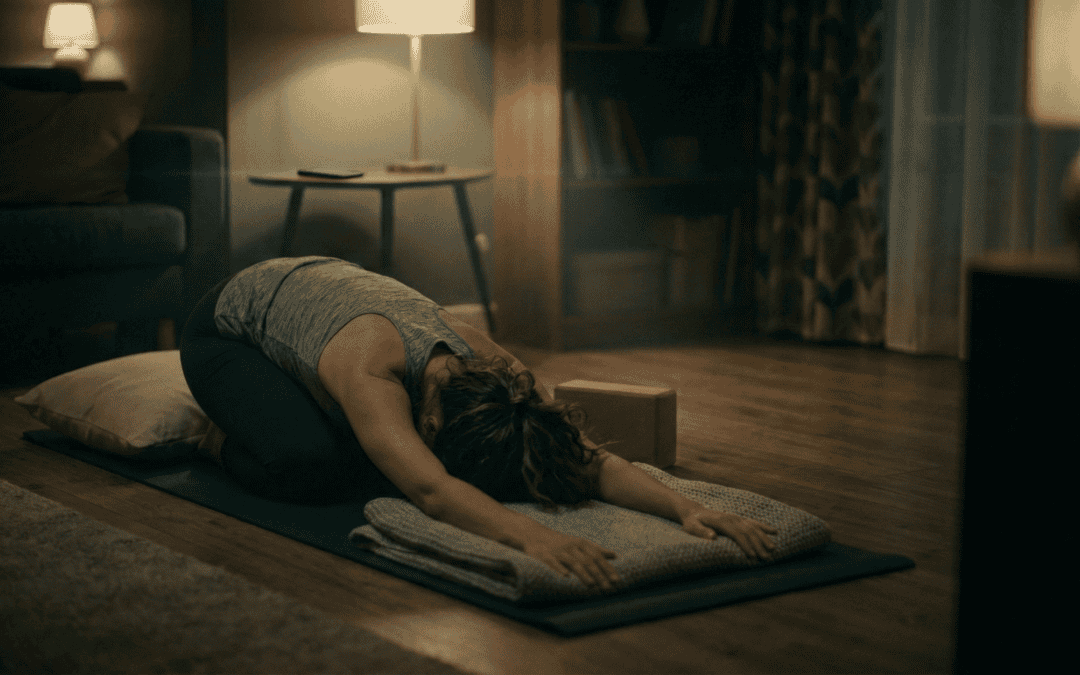
1) Supported Child’s Pose: Rest your forehead on support. Let the back of your ribs widen as you breathe in. Place a pillow or bolster under your chest and head so you do not have to fold deeply. If knees are sensitive, add a folded blanket behind the knees. Stay for 1 to 3 minutes.
2) Thread the Needle: Supports shoulders and upper back, which often feed into neck tension. Let the shoulder blade feel heavy without forcing it. Place a pillow under your head and chest so there’s no strain. Stay for 5 to 8 slow breaths each side.
3) Seated jaw and throat release (60 seconds): Let the tongue rest wide in the mouth. Unclench the teeth so there’s a tiny gap. Try 6 slow breaths. On each exhale, soften the jaw and the space behind the eyes.
4) Supine Figure 4: Flex the foot of the crossed leg to support the knee. Relax your shoulders and unclench your hands. If needed, place the bottom foot on a wall or a chair and keep it mild. Stay for 8 to 10 breaths each side.
5) Supported Bridge: Lift hips slowly, place support under the sacrum, then let the glutes relax. Use a block on the lowest height or a firm cushion. If your low back doesn’t love it, swap for constructive rest. Stay for 1 to 2 minutes.
6) Reclined Bound Angle: Support both thighs with pillows or folded blankets so there’s no pull through the groins. Add a blanket over the body for warmth. Stay for 2 to 4 minutes.
7) Legs Up the Wall: Settles restless legs and reduces the “buzzing” feeling. Scoot hips a little away from the wall. If you get pins and needles, try calves on a chair instead. Stay for 3 to 8 minutes.
Finish: Supported Savasana (final rest)
A clear signal to your nervous system that there’s nothing left to do. Let your body feel heavy. Use a pillow under knees and a blanket for warmth. Stay for 5 to 10 minutes. If the mind keeps talking, give it one job: feel the contact points only. Heels, calves, back of pelvis, shoulder blades, back of head.
If you’re already in bed: a 90-second reset
If getting up feels like too much, try this under the covers. Breathe out slowly through the mouth, like you’re gently fogging a mirror. Do 3 rounds. Let your shoulders drop heavy into the mattress. Unclench your tongue. Take 3 more breaths, making the exhale longer than the inhale.
Two tiny Sunday night supports
- Create a buffer before bed: Even ten minutes of lower stimulation can help. Dim lights, softer voices, fewer decisions.
- Be curious about timing: Experiment with earlier caffeine, and avoid alcohol close to bedtime for a week. Notice what changes, without judgement.
What to practise at Unplugged
If Sunday night jitters are a regular thing for you, Yin Rest on Sunday afternoon can be a beautiful way to change the tone of the day before the week begins. Shapes are mostly on the floor, held for longer, with plenty of support so your body can let go without effort.
Join us for Yin RestFriendly disclaimer: This post is general information and not medical advice. If sleep issues persist, please talk with your GP.