A Valentine’s Day for you: self-love, heart openers, and a week to unplug
It’s February in Brisbane. The air is thick by 6am, your water bottle is already warm, and the day starts with that familiar rush: school bags, traffic on Waterworks Road, inbox pings, sport training, family plans, work deadlines. Somewhere in the middle of it all, you might catch yourself thinking, I’ll take time for me… later.
If you feel that, you’re not alone. This time of year tends to shine a spotlight on love and effort. We book tables, buy gifts, write cards, plan surprises. We remember other people’s favourite flowers and food. We try, in a thousand small ways, to make others feel cared for. And yet when it comes to ourselves, care often becomes the thing we postpone.
This isn’t about spending Valentine’s Day alone or opting out of connection. It’s more like a gentle parallel: what would change if you gave yourself even a fraction of the attention you naturally offer others? Not a big makeover. Not a new version of you. Just a little more presence, a little more softness, and a few minutes a day to come back to your body.
What self-love actually looks like
Self-love is easy to talk about and strangely hard to practise. Because in real life, self-love doesn’t always look like bubble baths or affirmations. Often, it looks like:
- noticing you’re rushing, and taking one slower breath
- letting your shoulders drop without needing a reason
- pausing before you say yes automatically
- making time for a short stretch because your body asked, not because you “should”
- speaking to yourself the way you’d speak to a friend who’s doing their best
If that feels unfamiliar, you’re not broken. You’re human, living in a culture that rewards output and coping. Self-love is not a personality trait. It’s a practice.
What might be happening in the body
When life is busy, your body adapts. It tries to help. But those helpful patterns can get stuck on. Breathing often shifts higher into the chest. Stress commonly brings faster, shallower breathing. Better Health Channel notes that shallow, upper chest breathing is part of the typical stress response, and that consciously using the diaphragm can reduce that response.
The front of the body can tighten. Chest, jaw, throat, belly, and hip flexors often brace. Shoulders round forward. Upper back works overtime. Your nervous system can stay on alert. Even when you sit down, the system doesn’t always get the message that it’s safe to soften.
A simple way to work with this is to combine two things:
- a slightly longer exhale (to help downshift)
- gentle heart-opening shapes (to create space across the chest and front ribs)
A breath practice that fits real life: longer exhale breathing (3 to 5 minutes)
This is one of the simplest nervous-system-friendly tools, and it pairs beautifully with the “Mindful Breath” day in your Ritual of Presence download.
- Sit comfortably, or lie on your back with knees bent.
- Inhale through your nose for a natural count of 4.
- Exhale through your nose for a slightly longer count of 6.
- Repeat, keeping it soft and unforced.
If you feel dizzy, breathless, or uncomfortable, return to normal breathing. If you have a respiratory condition, check in with your clinician if you’re unsure what’s appropriate.
Heart openers as self-love: 6 poses (with cues and props)
A quick safety note: Heart openers should feel spacious, not sharp. If you feel pinching in the front of the shoulder, compression in the low back, or tingling/numbness, back out and choose a gentler option. If you’re pregnant, post-surgery, managing acute injury, dizziness, or worsening pain, get individual advice from a qualified health professional. Choose 4 to 6 of these and keep it simple.
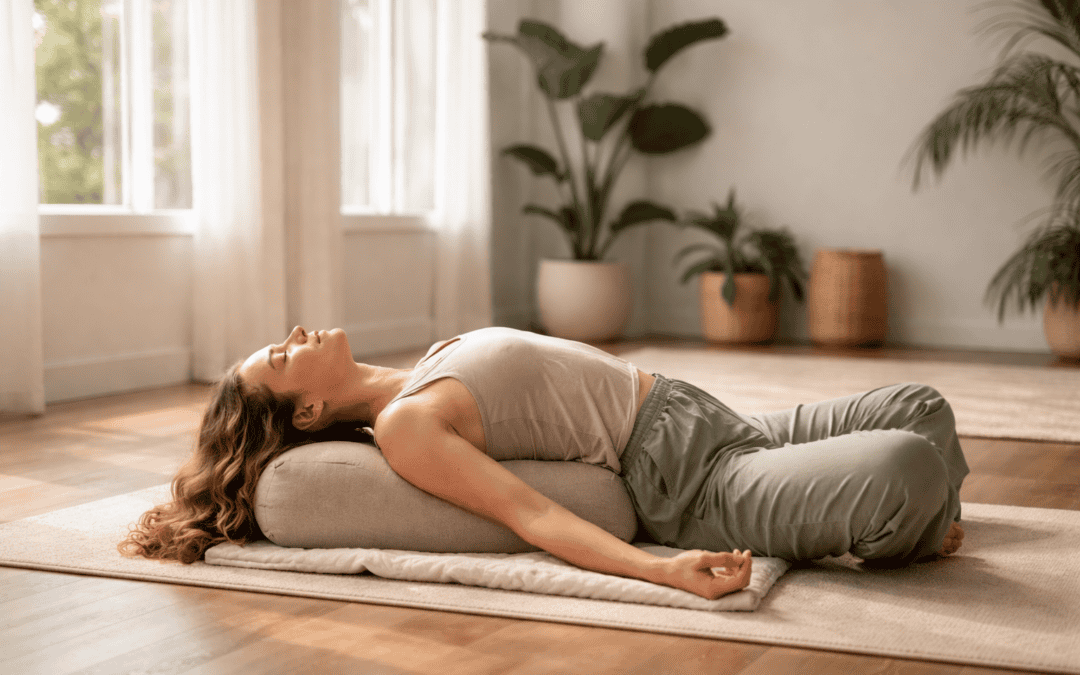
1) Supported Fish (restorative chest opener)
What it supports: breathing space, chest softness, gentle opening without strain.
Key cues: Let your ribs melt over the support. Soften your jaw and throat.
Prop-based modification: Place a bolster or rolled blanket lengthways along the spine. Support the head so the neck feels easy.
2) Sphinx Pose
What it supports: front-body opening, posture reset, steady breath.
Key cues: Press forearms down and broaden across the collarbones. Keep glutes relaxed.
Prop-based modification: Fold a blanket under the ribs or pelvis if your low back feels sensitive.
3) Puppy Pose (Anahatasana)
What it supports: opening through shoulders and upper back, space behind the heart.
Key cues: Keep hips stacked above knees. Reach forward without collapsing into the shoulders.
Prop-based modification: Rest forehead on a block or folded blanket to reduce intensity.
4) Low Lunge with gentle chest lift
What it supports: hip flexor release plus a mild heart opener (great after sitting).
Key cues: Soften front ribs down, then lift through the breastbone. Keep the back of the neck long.
Prop-based modification: Hands on blocks. If reaching arms up irritates shoulders, keep hands on hips or heart.
5) Supported Bridge
What it supports: calm, supported opening through front body; a great “end of day” pose.
Key cues: Feet grounded, knees tracking forward. Let breath broaden the chest.
Prop-based modification: Place a yoga block under the sacrum (lowest height first) and rest. If it feels too much, remove the block and hug knees in.
6) Reclined Bound Angle (Supta Baddha Konasana)
What it supports: downshifting, softening belly and chest, gentle closure.
Key cues: Shoulder blades heavy. Tongue relaxed.
Prop-based modification: Support thighs with blocks/cushions so hips can relax. Add a folded blanket under the head.
A simple 15-minute sequence:
Supported Fish (2 to 4 min) → Puppy (6 breaths) → Low Lunge (5 breaths each side) → Sphinx (6 breaths) → Supported Bridge (2 min) → Reclined Bound Angle (3 to 5 min) + longer exhale breathing.
The self-love piece people miss: consistency over intensity
A lot of us wait until we have the “right” mood or enough time. But self-love often works better as a rhythm than an event. That’s why short daily practices can be so powerful. They remove the decision fatigue. You don’t have to figure everything out. You just return to one small thing. The Black Dog Institute talks about self-care planning as a way to identify strategies that support your wellbeing, especially when life is busy and stressy.
Think of this as your February experiment:
- less “fixing”
- more noticing
- more small returns to yourself
Your February Gift to You: A Ritual of Presence
Download our simple 7-day guide: 7 Days to Unplug. A small daily ritual you can do in real life, even when the week is full.
Get the DownloadWhat to practise at Unplugged
If you’d like support to make this a real habit, it can help to choose a class based on how your nervous system is tracking that week, not what you think you should be doing. Slower, steadier classes often feel like a reset when you’re overloaded or wired-tired, because they give your breath and body time to land. More flowing classes can be a good match when you feel flat or stuck, especially if you treat the breath as the pace-setter and keep heart openers gentle rather than forced.
And if you’re navigating pain, an injury history, pregnancy, or post-surgery recovery, a private session can be a kinder starting point. It gives you space to explore supported chest openers and shoulder work in a way that fits your body on that day, with options that keep things steady and safe.
This is what a self-Valentine can look like: small, consistent acts of care that remind your body you’re on your own side. Take a moment. Unclench your jaw. Exhale. That’s enough for now.